Self Driving Cars

This slideshow requires JavaScript.

Self Driving Cars

For 125 years the automotive industry has been a force for innovation and economic growth. Now, in the early decades of the 21st century, the pace of innovation is speeding up and the industry is on the brink of a new technological revolution: “self-driving” vehicles.

The new technology could provide solutions to some of our most intractable social  problems—the high cost of traffic crashes and transportation infrastructure, the millions of hours wasted in traffic jams, and the wasted urban space given over to parking lots, just to name a few. But if self-driving vehicles become a reality, the implications would also be profoundly disruptive for almost every stakeholder in the automotive ecosystem. As one industry executive put it, “Everything, from how we move goods to how we move ourselves around, is ripe for change.

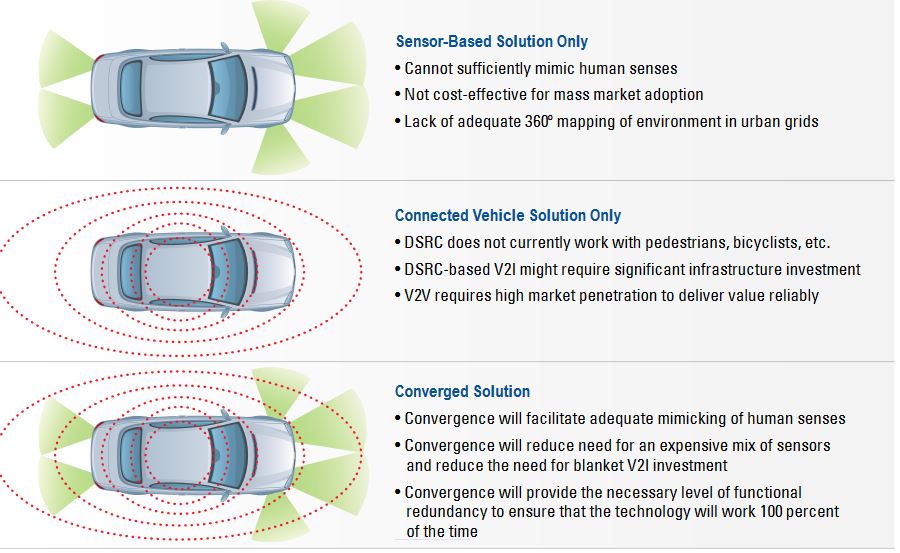
Self Driving Cars purely runs on SENSORS.

Capture

Three types of variations in cars.

  1. Sensor-based solution
  2. Interconnected vehicles and sensors
  3. Interconnected vehicle system, sensor and human movement.

There are many parameters to manage while considering a driverless car.

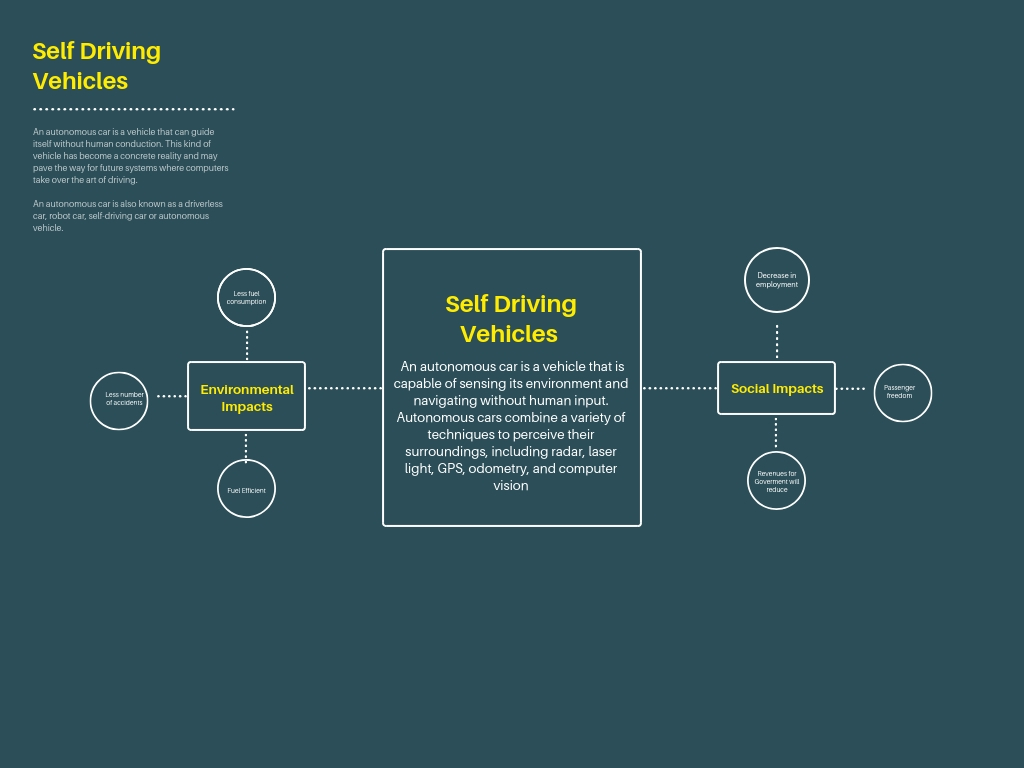
A brief idea about our presentation described by this infographic.

info.jpg

Environmental Impacts of Driver less cars

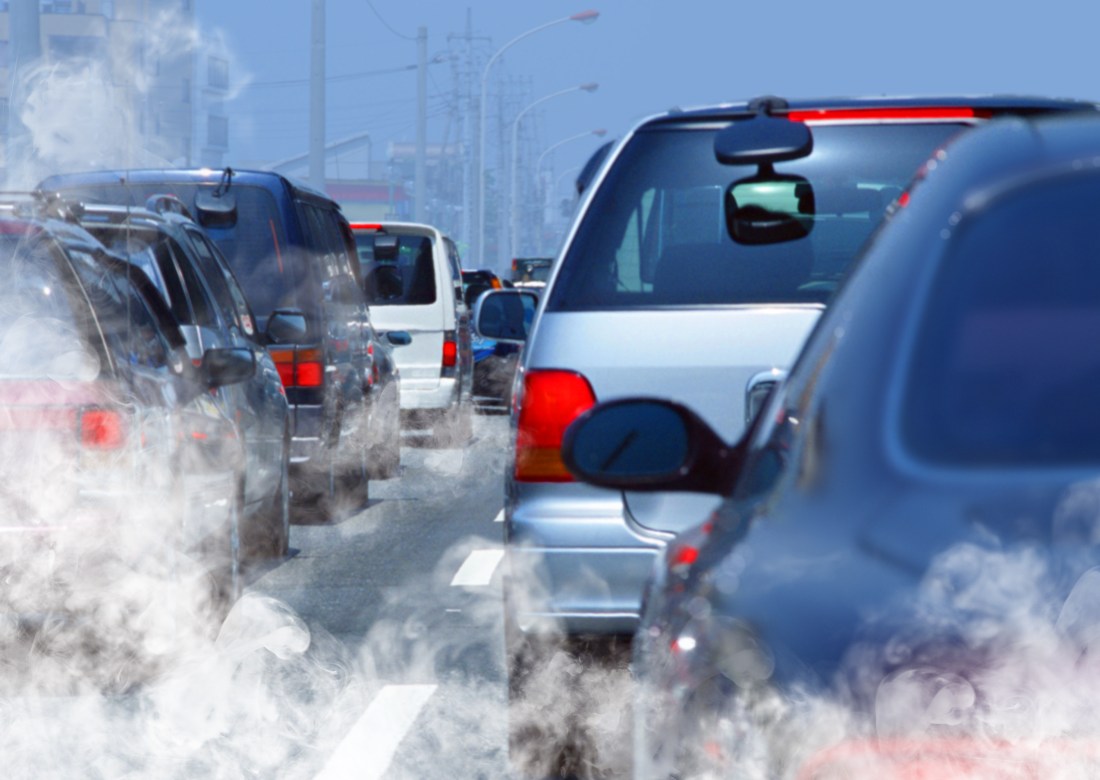
What about pollution?

Excitement around connected and autonomous vehicles has been building for years with consumers interested in the convenience of never having to touch the steering wheel and governments anticipating significant improvements in road safety. It’s presumed that these technologies will also have energy efficiency and emissions reductions benefits, but only recently have experts been able to quantify them.

shutterstock_40584751.jpg

A recent report by the Intelligent Transportation Society of America projects that so-called intelligent transportation systems (ITS) could achieve a 2 to 4 percent reduction in oil consumption and related greenhouse gas emissions each year over the next 10 years as these technologies percolate into the market.

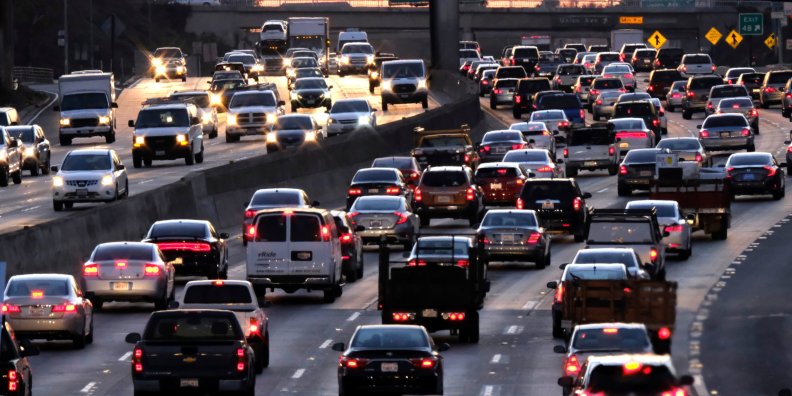
An end to traffic jams?

Researchers are developing new mathematical algorithms that will allow more vehicles and types of infrastructure to seamlessly exchange information and coordinate their actions to eliminate congestion.5a85e9f6d0307221008b4829-2732-1366.jpg

On the one hand, autonomous vehicles could encourage more driving and more emissions because people will opt for personal transport over public transit. Furthermore, if people don’t have to pay attention during their commute and can read the paper or play on their phone instead they might decide to live farther away from their workplace.

Safety benefits appeal to automakers.

According to the Department of Transportation, vehicle-to-vehicle communication has the potential to help unimpaired drivers avoid up to 80 percent of vehicle crashes.

Policymakers are still in the learning phase for some of these things.


Social Impacts of Driver-less Cars

Decrease in employment.

stress-1500pxs.jpg

That’s a LOT of truck drivers. According to the Bureau of Labor Statistics, there were approximately 1.6 million American truck drivers in 2014 earning a mean income of $42,000. That’s more than half a percent of the country, and $67 billion dollars in income – about 0.3% of the US GDP.

These new trucks aren’t completely autonomous yet, but the technology is going to get there sooner rather than later. And when that day arrives, those truck drivers will need to find something else to do. When you include delivery truck operators, which numbered around 800,000 in 2014, we end up with 2.4 million people who may be out of a job in the next decade or two.

Government revenues will reduce.

When it comes to public finances, government officials tend to live in the moment. They might want to make an exception in this case.

Reduced car ownership will mean fewer automobile sales to tax. But perhaps more important, cops and meter maids will write a lot fewer tickets because smart cars presumably won’t double park, change lanes without signalling or bust through the speed limit. Since cars sit empty about 95 per cent of time, self-driving cars can greatly increase efficiency by constantly being in use.

Passenger freedom.

Dash.jpg


In department of driverless vehicles one of the most common name is Waymo. As Waymo and its many rivals prepare to roll out driverless cars to consumers, one of their challenges has been to design an experience for riders that feels both convenient and safe. Passenger can experience some sort of things like:

  • Getting a ride and starting off.
  • Seeing what the car sees.
  • Handling unsafe conditions or an accident.

Summary of the topic

Summary

Recent announcements that manufactures will soon sell
self-driving cars raise hopes that autonomous vehicles will quickly solve many transportation problems. Advocates predict that by 2030, such vehicles will be sufficiently convenient and affordable to displace most human-operated vehicles,providing many savings and benefits to users and society overall.
his2
Overall, the question is not whether cars will become autonomous, but rather how the
progressive shift towards driver-less vehicles will come about, how they will coexist
alongside traditional vehicles and how they will steer the change.

The main question is are we prepared for accepting this change?

References…..

Autonomous driving: Technical, legal and social aspects. Berlin: Springer OPen.      doi:10.1007/978-3-662-48847-8

Curr Sustainable Renewable Energy Rep (2015) 2:74–81 DOI 10.1007/s40518-015-0038-5

Consumer Reports. “Manual vs Automatic Transmission: Save Money.” Consumer Reports. October 2014. (April 22, 2015) http://www.consumerreports.org/cro/2012/01/save-gas-and-money-with-a-manual-transmission/index.htm

Data on sustainable cities and communities discussed by researchers at singapore national university (Autonomous vehicles for smart and sustainable cities: An in-Depth exploration of privacy and cybersecurity implications).(Report). (2018). Ecology, Environment & Conservation, 123, 123-123.

Fernandes, P., Coelho, M., & Rouphail, N. (2017). Assessing the impact of closely-spaced intersections on traffic operations and pollutant emissions on a corridor level. Transportation Research Part D, 54, 304-320. doi: 10.1016/j.trd.2017.05.016

Litman (2017).;House of Representatives Standing Committee on Industry, Innovation, Science an Resources, South Australia

Lim, Hazel S.M.; Taeihagh, Araz. 2018. Autonomous Vehicles for Smart and Sustainable Cities: An In-Depth Exploration of Privacy and Cybersecurity Implications. Energies 11, no. 5: 1062. doi: 10.3390/en11051062

Magliozzi, Ray and Tom. “Manual vs. Automatic: Which Gets Better Mileage?” Car Talk. Aug. 24, 2014. (April 22, 2015) http://www.cartalk.com/blogs/tom-ray/manual-vs-automatic-which-gets-better-mileage

Moskalik, A., Hula, A., Barba, D., and Kargul, J., “Investigating the Effect of Advanced Automatic Transmissions on Fuel Consumption Using Vehicle Testing and Modeling,” SAE Int. J. Engines 9(3):2016, doi:10.4271/2016-01-1142

Ramsey, Jonathan. “Why Automatics Are Catching Up in Fuel Economy and Performance.” AutoBlog. July 17, 2010. (April 22, 2015) http://www.autoblog.com/2010/07/17/automatic-transmission-better-fuel-economy/

Zhu, H., Yuen, K., Mihaylova, L., & Leung, H. (2017). Overview of environment perception for intelligent vehicles. Ieee Transactions on Intelligent Transportation Systems, 18(10). doi:10.1109/TITS.2017.2658662